LAND AN DELIVER – EPISODE 015
Read The Show Notes
AI tools are everywhere.
ChatGPT. Copilot. Gemini. Canva. Photoshop. And a growing list of others, all promising to save time, improve your work and make life easier.
But that creates a problem.
When every tool says it can help, how do you know which one to use?
For business owners, marketers, communicators and content creators, AI can feel exciting and overwhelming at the same time. You know there is value in it. You know it can speed things up. You know people around you are starting to use it. But when the choice feels endless, it is very easy to freeze before you even begin.
The good news is you do not need to use every AI tool.
You just need to understand what each one is useful for, how it fits into the way you already work and where it can genuinely make your life easier.
ChatGPT can be brilliant for thinking, shaping ideas, summarising conversations, understanding a client’s world and getting you off the blank page.
Microsoft Copilot can be useful if your business already lives inside Microsoft, helping with documents, proposals, emails, meetings and everyday workflows.
Google Gemini may make sense if you are working across Gmail, Google Docs and Google Slides.
Canva and Photoshop can help with layouts, visuals, image editing and creative shortcuts that once took hours.
But useful does not mean flawless.
AI can create work quickly, but it can also make mistakes quickly. It can misspell words, misunderstand context, generate odd images, invent details or produce something that looks polished but still needs a proper human check.
And that matters.
Especially when the output is going to a client, a customer, a colleague or a wider audience.
This is where judgement comes in.
Start with the problem, not the platform.
Ask what you actually need the tool to do. Are you trying to think, write, summarise, design, edit, organise or speed something up?
Then give it proper context. Use plain English. Tell it who the work is for. Explain what you want it to achieve. Check what it gives you. Refine it. Question it. Make sure the final version says what you actually mean.
Because the tool is not the decision-maker.
You are.
Get that right, and AI starts to feel less intimidating. It stops being a confusing wall of shiny software and becomes a practical toolkit.
One tool might help you think.
Another might help you write.
Another might help you design.
Another might help you save half a day on something that used to take forever.
The point is not to use AI for the sake of it.
The point is to choose the right tool, use it well and keep your human judgement firmly in charge.
In this episode of Land and Deliver, Darren Wingham and Louise Chandler-Rutt look at a very practical AI question.
Which tool should you actually use?
Because AI tools are everywhere now.
ChatGPT. Microsoft Copilot. Google Gemini. Canva. Photoshop. And plenty more, all promising to save time, improve your work and make everyday business life easier.
But when every platform claims to be the answer, it can quickly become overwhelming.
The real challenge is not chasing every new tool. It is working out what you need help with, choosing the tool that fits that job and using it in a way that still keeps your judgement, your voice and your human input at the centre.
Darren and Louise talk about the strange moment many people experience when they first open an AI tool. After all the hype, you are often faced with a blank box.
No big magic button.
No obvious starting point.
Just a space waiting for you to tell it what you want.
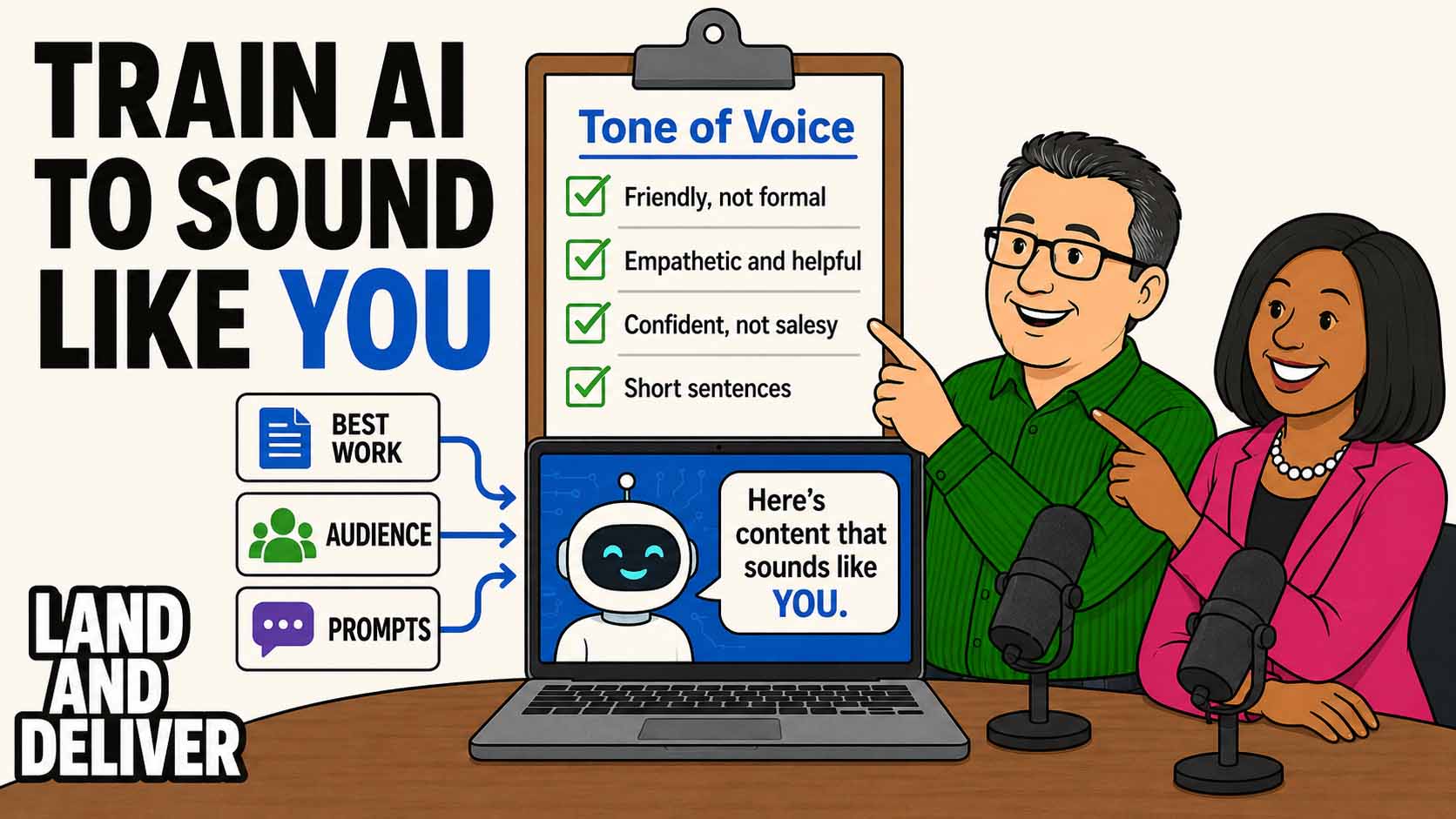
That is why the real skill is not coding. It is not technical wizardry. It is learning how to talk to AI clearly. Using plain English. Giving it context. Explaining the audience. Asking better questions. And knowing when to challenge what comes back.
The episode explores how ChatGPT can help with client conversations, summaries, content ideas, creative development and getting off the blank page. Darren explains how he uses it to absorb information quickly, understand a client’s world and turn long conversations into sharper, more useful content.
Louise explains why Microsoft Copilot can be helpful for people already working inside the Microsoft world, especially across Teams, Outlook, Word, PowerPoint and proposals. But she also shares an important warning. AI can produce something that looks polished and impressive, while still containing spelling mistakes, strange choices or details that only a proper human review will catch.
They also look at Google Gemini, and how it can make sense for people who already work across Gmail, Google Docs and Google Slides.
Then the conversation moves into creative tools like Canva and Photoshop. These can help with layouts, visual ideas, image editing, photo fixes, podcast artwork, one-page documents and social graphics. They can remove reflections, balance lighting, tidy up images and speed up jobs that used to take hours.
But again, useful does not mean flawless.
You still need to check what they produce.
Drawing on examples from photography, proposals, newsletters, podcast artwork, business documents and creative workflows, Darren and Louise explain why AI should be treated as a toolkit, not a magic answer.
One tool might help you think.
Another might help you write.
Another might help you design.
Another might help you save half a day on something repetitive.
The trick is knowing what you need before you decide which tool to use.
If you are curious about AI but not sure where to start, this episode offers a calm, practical and human guide. It is not about using every tool. It is about choosing the right one, learning how to speak to it, checking the results and making sure the final work still sounds like you.
Share This Story, Choose Your Platform!

HEAR THE WHOLE SERIES ON YOUR FAVOURITE PODCAST PLAYER



About Darren & Louise
Louise’s work

Our blog is packed with articles and stories based around lifestyle, business, design and wellbeing. Subscribe now to get all of our updated directly to your inbox every week.