SHOW NOTES
Land and Deliver
Episode 15: How to Use AI Without Losing Your Voice
Hear or view the full episode here.
What this episode is about
AI can save you time.
It can get you off the blank page.
It can help with emails, proposals, articles, social posts, scripts, presentations and all the other content that seems to multiply when your back is turned.
But that creates a problem.
If everyone is using AI to write, how do you stop your work sounding like everyone else’s?
In this episode of Land and Deliver, Darren Wingham and Louise Chandler-Rutt explore how to use AI without losing your voice, your judgement or the human bits that make your message connect.
They look at why AI can be useful, but also why it can so easily create generic, polished, slightly soulless content if you do not give it enough context.
The conversation explores tone of voice, prompting, audience, emotion, memory, training data and how to help AI understand the way you actually communicate.
Darren and Louise talk about why AI does not automatically know who you are, why it can make confident assumptions, and why a simple instruction like “make it sound like me” is rarely enough.
The key message is simple.
AI can help you write faster.
But it still needs your examples, your judgement, your audience insight and your human voice.
The core idea
AI does not automatically know your voice.
It knows patterns.
It knows averages.
It knows what lots of other people have written before.
But it does not know the way you speak, the people you are trying to reach, the examples you use, the emotional effect you want to create or the phrases that feel natural to you.
That is why tone of voice matters.
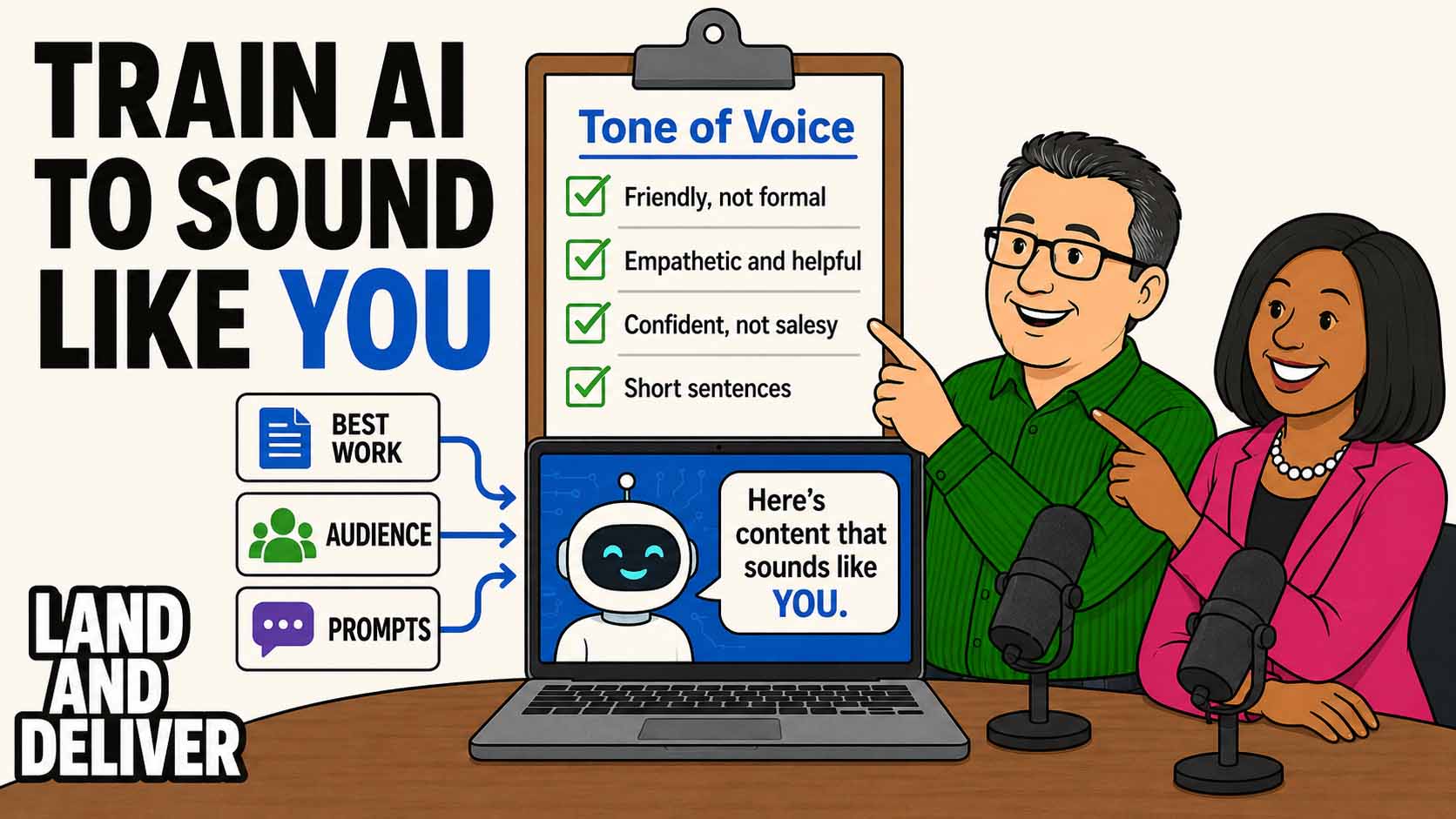
If you want AI to sound more like you, you need to train it properly. Give it examples. Tell it who you are speaking to. Explain the context. Show it your best work. Ask it to interview you. Challenge what it gives back.
AI is not the voice.
You are.
The tool can help shape, speed up and sharpen your work, but the final message still needs to feel human, clear and true to you.
Key themes and thinking
A central theme in this episode is sameness.
If lots of people are using similar AI tools in similar ways, there is a real risk that business communication starts to sound flat, safe and generic.
Another theme is training. AI is only as useful as the information you give it. If you do not give it your tone, your audience, your values, your examples and your intent, it will fill in the gaps with assumptions.
The conversation also explores the idea that your voice changes depending on who you are talking to. You do not speak to a client in exactly the same way you speak to a close friend, a sibling, a teenager, a stressed business owner or a senior decision-maker. AI needs that context too.
There is also a strong focus on emotion. AI can structure information, suggest wording and tidy up content, but it does not automatically understand how you want someone to feel. If your message needs to reassure, inspire, challenge, encourage or create urgency, you need to bring that emotional intelligence into the process.
Finally, the episode highlights consistency. A tone of voice document can help AI produce more useful first drafts because it gives the tool a clear reference point. Instead of explaining yourself from scratch every time, you can build a repeatable guide that helps your AI output stay closer to the way you want to sound.
Frameworks, models, and mental shortcuts
This episode introduces a practical way to think about training AI to write more like you.
The AI Tone of Voice Training Guide.
1: Ask what AI already knows about you
Start by testing the tool.
Ask it what it knows about you, your business or your role.
You may find that it knows very little. You may find that it makes assumptions. You may find that some of what it says is wrong.
That is useful information.
It shows you the gap between what the tool thinks it knows and what you actually need it to understand.
2: Do not assume it knows your voice
AI does not automatically know how you speak.
It does not know your favourite phrases, your pace, your level of humour, your examples or the way you explain things.
If you want it to sound more like you, you need to give it that information.
3: Let AI interview you
Instead of trying to write the perfect prompt straight away, ask AI to ask you questions.
For example, you can say:
Ask me ten questions about my tone of voice before you write this.
Or:
Ask me whatever you need to know so you can write this in a way that sounds like me.
This turns AI into a useful interviewer. It helps pull out the details you may not think to include in the first instruction.
4: Give it your best work
If you have written blogs, emails, proposals, speeches, social posts or articles that feel like you, use them as examples.
AI is good at spotting patterns across larger amounts of text.
The more useful examples you give it, the easier it becomes for the tool to understand what you mean by your tone of voice.
You can also give it examples of other people’s work you admire, as long as you use that as inspiration rather than imitation.
5: Tell it who the audience is
Tone changes depending on who you are talking to.
A message for a teenager will sound different from a message for an overwhelmed business owner.
A message for a senior leader will sound different from a message for a nervous first-time podcast guest.
Tell AI who the work is for, what they care about, what they already know and how you want them to feel.
6: Include emotion and intent
AI can be neat, but neat is not always enough.
Sometimes your message needs to reassure.
Sometimes it needs to challenge.
Sometimes it needs to create confidence, urgency, trust or curiosity.
Tell the tool what emotional effect the content needs to have. Then check whether the result actually creates that feeling.
7: Build a tone of voice document
A tone of voice document gives AI a consistent reference point.
It can include who you are, what you do, who you talk to, how you explain things, words you use, words you avoid, examples of your best work and the kind of emotional tone you want to create.
Once you have it, you can upload it or refer to it when asking AI to help with writing.
That means you are not starting from scratch every time.
8: Keep checking and updating it
Your voice changes over time.
Your business changes.
Your audience changes.
AI tools change too.
A tone of voice document is not something you create once and forget. It should evolve as you learn what works and what does not.
What to avoid
Assuming AI automatically knows you
It probably does not.
Even if it can find information about you online, that does not mean it understands your tone, values, audience or intent.
Using vague tone instructions
“Make it friendly” or “make it professional” can help a little, but they are not enough on their own.
Be more specific.
Friendly in what way?
Professional for whom?
Warm, direct, playful, calm, challenging, reassuring or conversational?
The more specific you are, the better the output is likely to be.
Copying and pasting without editing
AI can give you a starting point, but that does not mean it is finished.
Read it properly. Cut the bland bits. Add your own examples. Check the tone. Make sure it sounds like something you would actually say.
Letting AI over-polish your writing
AI often likes to make writing smooth, tidy and balanced.
That can be helpful.
But too much polish can remove personality.
Do not be afraid to put some of the human texture back in.
Forgetting who you are speaking to
Tone of voice is not just about you.
It is also about the person receiving the message.
If AI does not know who the audience is, it will guess.
Relying on AI for emotion
AI can imitate emotional language, but it does not feel the situation.
If your message needs empathy, reassurance, humour, sensitivity or conviction, that needs a human check.
Thinking one document solves everything forever
A tone of voice document is a living tool.
Update it as your work, audience and style evolve.
Applying this thinking in practice
Open your AI tool and ask it what it knows about you, your role or your business.
Check what it gets right.
Check what it gets wrong.
Notice what is missing.
Then begin building a simple tone of voice document.
Include who you are, what you do, who you help and how you want to come across.
Add examples of your best writing.
Include phrases you use often.
Add words or styles you want to avoid.
Explain who your main audiences are and how your tone changes depending on the situation.
Before asking AI to write something important, ask it to interview you first.
Tell it to ask questions about the audience, the purpose, the emotional tone and the outcome you want.
Use those answers to create a better prompt.
When AI gives you a draft, do not just accept it.
Ask whether it sounds like you.
Look for generic phrases.
Remove anything that feels too polished, too bland or too far away from how you would naturally explain the idea.
Add real examples.
Add your judgement.
Add the human bit.
Upskilling your comms team
Help your team understand that AI can support tone of voice, but it cannot own it.
Start by agreeing what your organisation should sound like.
Look at examples of content that feel right.
Look at examples that feel wrong.
Talk about why.
Create a shared tone of voice document that includes audience, values, language, examples, emotional intent and common pitfalls.
Encourage people to use AI as a drafting partner, not a final approver.
Show them how to ask AI to interview them before creating content.
Teach them to include audience and context in every prompt.
Build in review stages so AI-assisted content is checked for accuracy, tone, empathy and meaning.
Encourage people to challenge AI when it produces something bland, generic or too polished.
Keep the tone practical.
The aim is not to stop people using AI.
The aim is to help them use it in a way that keeps the organisation’s voice recognisable, trustworthy and human.
Common pitfalls discussed
Sounding like everyone else because the prompt is too generic
Assuming AI knows your background, business or voice
Trusting confident AI assumptions
Using AI without checking what it has remembered
Forgetting to tell AI who the audience is
Asking for tone of voice without giving examples
Letting AI remove personality in the name of polish
Expecting one prompt to capture every nuance
Forgetting that tone changes depending on context
Leaving emotion out of the instruction
Using AI as a source of truth rather than a support tool
Failing to update your tone of voice guidance over time
Memorable lines and moments
“How can you make it still sound like you?”
“The win with AI is that it is fast. It gets you off that blank page.”
“You are not a conglomerate of all human beings that have ever written on the internet.”
“AI knows nothing about you.”
“It is very confident in making assumptions.”
“Ask me ten questions.”
“Tone of voice changes depending on who you are talking to.”
“Useful does not mean flawless.”
“It can never be 100% me, but it can be the me I want to be.”
“The tool is not the voice. You are.”
Key moments and timecodes
00:00 Welcome to Land and Deliver
00:05 Introducing the AI tone of voice problem
00:29 If everyone is using AI, how do you still sound like you?
00:57 Why AI can create generic content
01:37 The risk of sounding like everyone else
02:22 How well does AI actually know you?
03:05 Introducing the tone of voice document
04:33 Why AI automatically knows very little about you
05:45 AI as an intern with lots of information but little context
06:46 Should AI interview you?
06:57 AI, people pleasing and confident assumptions
08:15 Testing what AI knows about you or your business
09:42 Getting AI to interview you before it writes
10:29 Asking AI to ask better questions
11:37 Why audience changes tone of voice
12:53 Emotion, intent and why AI does not always understand feeling
15:08 AI agreeing with you and why you need to make it think harder
16:25 Training AI using your best work
17:04 How the tone of voice document helps
18:05 Giving AI examples and larger amounts of useful information
19:57 Can AI ever sound 100% like you?
21:34 Working rules for using the tone of voice document
23:06 Key takeaways
24:06 Where to find the downloadable tone of voice document
Useful links
landanddeliver.co.uk – All about the podcast and episodes
WIDEO.co.uk – Darren’s work
soundbitemedia.co.uk – Louise’s work
Where this thinking leads
Land and Deliver is about helping messages land in a way that people understand, care about and act on.
If this episode has made you rethink how you use AI for writing, the next step is not to stop using it.
The next step is to train it better.
Start with your voice.
Give it examples.
Tell it who you are speaking to.
Explain the context.
Ask it to interview you.
Check what it gives back.
Then edit it until it sounds like something you would actually say.
AI can help you move faster, but speed is not the only goal.
The goal is to communicate clearly, consistently and humanly.
Use the tool.
Keep your judgement.
Protect your voice.
You can explore more frameworks, examples and practical tools at landanddeliver.co.uk.
Share This Story, Choose Your Platform!


HEAR THE WHOLE SERIES ON YOUR FAVOURITE PODCAST PLAYER



About Darren & Louise
Louise’s work

Our blog is packed with articles and stories based around lifestyle, business, design and wellbeing. Subscribe now to get all of our updated directly to your inbox every week.